The Scarlet Forum Academic Journal

The Far-reaching and Diverse Career Choices Master’s Degree in Business Administration Yields
It All Begins Here
"Many people assume government work is slow or purely bureaucratic. In reality, the pace is intense, the decisions are high-stakes, and the consequences are very real."
- Erica Roach, Deputy Comptroller of Revenue Operations for the State of Maryland
Erica Roach’s background spans more than 25 years across public-sector finance, technology, and large-scale modernization initiatives, including senior leadership roles at the state and federal levels of government and in private-sector management consulting. She previously served at the United States Office of Personnel Management (OPM), overseeing over a trillion dollars in assets, led significant financial system modernization efforts, and spent many years teaching business project management and information systems in higher education.
The following is an interview with Erica Roach, Deputy Comptroller of Revenue Operations for the State of Maryland, discussing her career path and how earning a Master of Business Administration (MBA) has impacted her professional journey.
Q: How has your Master of Business Administration shaped your employment marketability?
A: My MBA degree included a strong focus on information systems, and I also have a Master of Public Management with a concentration on public policy and economics. My education opened up a world of possibilities for me. It prepared me for the challenges that lay ahead at both the state and federal levels. The combination of policy knowledge, technical expertise, and operational leadership has prepared me quite well for the complexity of my current role.
Q: What is a typical day for you in your position as Deputy Comptroller for Maryland?
A: No two days are the same, which is part of the appeal. A typical day involves meeting with senior leaders across tax processing, compliance, and taxpayer services; reviewing operational and performance data; resolving escalated taxpayer or legislative issues; and making decisions that balance policy intent, operational reality, and taxpayer impact. I also spend a lot of time coaching leaders, aligning teams around priorities, and preparing the organization for modernization and change.
Q: What drew you to a government leadership position, particularly in revenue operations?
A: I was drawn to the opportunity to make a real, visible impact on how the state of Maryland serves taxpayers. Revenue operations touch millions of residents and businesses every year. I saw the chance to improve systems, processes, and culture at scale while ensuring fairness and accountability.
[Commentary: Growing up as the daughter of hardworking immigrant parents, Erica expressed that she realized early on that education and determination were her keys to a better future, and she naturally gravitated towards the opportunity to make a difference. Her strong educational background blends with the demands of both high-stakes government positions and powerhouse corporations. Erica’s responses made me wonder how gratifying it must be to see the results of her work in real time.]
Q: Do you ever get a feeling of satisfaction or an acknowledgment from others when you see your work successfully implemented? If so, how does that feel?
A: Absolutely. The most rewarding part of my job is seeing those tangible improvements. Whether that’s faster resolution of taxpayer issues, better tools for staff, or training other team leaders to help them grow into their roles, knowing that my work helps the government be more effective, more accountable, and more humane is deeply satisfying. In fact, the most interesting aspect of my job is solving problems that do not have a single correct answer. Every decision requires balancing compliance, efficiency, technology, human behavior, and the taxpayer experience. Seeing how small changes in process or communication can dramatically improve outcomes is incredibly rewarding.
[Commentary: What stood out most during the interview was the emphasis on service and accountability. Her motivation for taking on this role is rooted in a desire to improve how the government interacts with the public. She clearly let me know that, for her, revenue operations are not just administrative functions but a direct reflection of public trust. I wondered if there was an aha moment that led her to know this field was her passion in life.]
Q: Was there ever a moment or event where you realized this is what you were meant to do in life?
A: Yes. Early in my career, I worked on large government systems that affected millions of people, often behind the scenes. While working at OPM, I realized that strong financial and operational leadership can quietly—but profoundly—improve people's lives. That's when I knew I wanted to focus on roles where strategy, systems, and public service come together.
Q: What is something people outside your work usually misunderstand about your job?
A: Many assume government work is slow or purely bureaucratic. In reality, the pace is intense, the decisions are high-stakes, and the consequences are very real. There is also a frequent misconception that revenue work is solely about enforcement, when in reality, a significant aspect of the job involves service, education, and problem-solving.
[Commentary: Erica’s perspective debunks common assumptions about government work and highlights its human impact. My interview with her also revealed the pressures that come with leadership at such a large scale. Change within government systems is far from simple; her responses highlighted the careful balance required to modernize while maintaining the public’s trust. I understand now, from her, that a top-level position like hers demands patience, resilience, and the ability to navigate uncertainty. As the conversation turned to the difficulties of her role, I wanted to learn more about how she must deal with all the pressures of her job.]
Q: What is the most challenging part of your work?
A: The most challenging part is driving change in complex organizations while maintaining continuity and trust. Modernization takes time, and people are understandably cautious when systems or processes affect their livelihoods or the public. Balancing urgency with care is never easy.
[Commentary: Erica’s advice highlights that even the most accomplished individuals sometimes struggle to maintain balance. As a Rutgers student, I frequently grapple with self-doubt and uncertainty as I juggle academic responsibilities and make decisions about my future. This led me to wonder if Erica herself has ever faced anxiety or uncertainty.]
Q: I can only imagine the intensity of the public scrutiny that comes with having such a high-level position. Has that ever led to feelings of self-doubt? If so, how do you cope with that type of pressure?
A: Absolutely. Leading at scale comes with constant scrutiny and pressure. When doubt creeps in, I rely on preparation, data, trusted colleagues, mentors, friends, and reflection. Throughout my career, I learned to view uncertainty as a signal to listen more closely, not as a weakness.
[Commentary: Erica’s candid response is a welcome revelation that, like many leaders, self-doubt is a familiar feeling and part of her journey as well. For college students like me, who are just beginning their own career journeys and often face similar feelings of anxiety and uncertainty, her openness is both reassuring and inspiring.]
Erica Roach’s experience demonstrates how thoughtful leadership can influence large institutions in meaningful ways. During our conversation, it became clear that for her, leadership is not about authority, but about responsibility. She emphasized that the rewards outweigh the challenges. Knowing that her work makes our government more effective, accountable, and humane is a deeply satisfying revelation. Despite the daunting complexity of her position, it’s evident that she’s fostered a positive environment for herself and has turned the challenges of her job into opportunities.
Ultimately, our interview reinforced a core belief in me. Erica taught me that true leadership is about service; titles matter far less than clarity, integrity, and empathy. Her insights helped me see how government, often perceived as distant and impersonal, is actually shaped by dedicated individuals working behind the scenes. Erica proved that strong leadership can ripple through an entire system, making even large institutions feel more personal and less out of touch with the public. The interview offered insight from an honest voice in a field of government that often goes unnoticed, yet plays a vital role in everyday life. Through Erica’s insightful responses, I realized that government work is extremely challenging, especially at a top-level position like hers. But more importantly, I learned that one person can make a difference, and I walked away with a renewed belief in the power of public service—and the people who devote themselves to it.
Environmental Racism in Regard to the AI Boom
It All Begins Here
Environmental racism refers to the disproportionate exposure of marginalized racial and ethnic communities to environmental hazards and limited access to environmental benefits. This research paper examines environmental racism in Memphis, Tennessee, drawing on historical analysis and contemporary reports. Using the “Long Lives Memphis” project as a case study alongside academic research on environmental racism and technology, this paper argues that systemic inequalities, which are rooted in segregation, urban planning, and economic marginalization, have shaped environmental disparities in Memphis. It also explores how modern technologies, including artificial intelligence (AI), may both aggravate and help address these inequities. Ultimately, this paper highlights the persistence of environmental injustice and the need for policy interventions grounded in equity and human rights.
Research
Environmental racism in Memphis is deeply tied to the city’s history of racial segregation and uneven urban development. The “Long Lives Memphis” project illustrates how life expectancy varies dramatically across neighborhoods, often along racial and economic lines. Communities with higher proportions of Black residents tend to experience shorter life expectancies, which are closely linked to environmental conditions such as pollution exposure, lack of green space, and proximity to industrial sites.
Historically, discriminatory housing policies, like redlining, confined Black residents to specific areas of the city. These neighborhoods were often located near highways, factories, and waste facilities, leading to increased exposure to pollutants. Over time, this residential inequality became embedded within the city of Memphis, reinforcing the concepts of poverty and environmental degradation. The results in a clear pattern, showing the juxtaposition between race and economy, and how they shape health outcomes and environmental risk.
(insert data from “Long Live Memphis”)
The “Long Lives Memphis” data demonstrates that environmental factors are connected with broader social problems relating to health. Poor air quality, limited access to clean water, and inadequate infrastructure contribute to higher rates of chronic illness, including asthma and cardiovascular disease. These conditions disproportionately affect marginalized communities, which highlights the structural nature of environmental racism.
This pattern aligns with broader definitions of environmental racism found in academic literature. Environmental racism involves “unequal access to a clean environment and basic environmental resources based on race” . In Memphis, this inequality is evident in the uneven distribution of environmental burdens and benefits. Wealthier, predominantly white
neighborhoods often have more parks, cleaner air, and better infrastructure, while poorer, predominantly Black neighborhoods face higher environmental risks.
(Graph showing quality of environment in PW vs PB neighborhoods in Memphis)
In addition to historical factors, contemporary economic and political dynamics continue to shape environmental inequality in Memphis. Industrial development is often concentrated in areas with less political power, where residents may lack the resources to resist harmful projects. This creates a cycle in which vulnerable communities are repeatedly targeted for environmentally hazardous activities.
The role of technology, particularly artificial intelligence, introduces a new aspect of environmental racism. As discussed in the cited research, AI systems are not neutral as they reflect the biases present in the data used to train them and the perspectives of their developers. This has important implications for environmental policy and planning. For example, data-driven tools used to allocate resources and predict environmental risks may inadvertently prioritize certain communities over others, reinforcing existing inequalities.
Another concern is the environmental impact of AI itself. The development and use of AI technologies require significant energy and resources, contributing to carbon emissions and environmental degradation. These impacts are not evenly distributed as marginalized communities are more likely to bear the environmental costs of technological development while benefiting less from its advantages. This creates what scholars describe as a “double burden,” where disadvantaged populations face both environmental harm and limited access to technological benefits.
Despite these challenges, AI also has the potential to address environmental racism if used responsibly. For instance, AI-driven tools can improve environmental monitoring, predict pollution patterns, and enhance disaster response. These capabilities could help identify and mitigate environmental risks in vulnerable communities. However, achieving this requires careful attention to issues of equity, transparency, and accountability.
A human rights framework provides a useful lens for addressing environmental racism in Memphis. Principles of equality and non-discrimination emphasize that all individuals have the right to a safe and healthy environment. Applying these principles to environmental policy means ensuring that marginalized communities are not disproportionately burdened by environmental hazards and that they have meaningful participation in decision-making processes.
In Memphis, this would involve addressing both historical injustices and contemporary disparities. Policies could include stricter regulation of industrial pollution, investment in infrastructure and green spaces in underserved neighborhoods, and community engagement in environmental planning. Additionally, efforts to improve data collection and transparency could help ensure that technological tools are used in ways that promote equity rather than reinforce inequality.
Conclusion
Environmental racism in Memphis is the result of long-standing structural inequalities rooted in segregation, economic disparity, and unequal political power. The “Long Lives Memphis” project highlights the tangible consequences of these inequalities, showing how environmental conditions directly impact life expectancy and health outcomes.
The integration of modern technologies, such as artificial intelligence, adds complexity to the issue. While AI has the potential to improve environmental outcomes, it also risks increasing existing inequalities as it is not carefully regulated. Bias in data, unequal access to technology, and the environmental costs of AI development all contribute to the ongoing challenges of environmental justice.
Venezuela, U.S. Sanctions, and Shifting Global Power
It All Begins Here
U.S. sanctions on Venezuela can be perceived to have an inward focus, however the intervention will cause effects beyond Venezuela and their people. By obtaining Venezuela’s authority, the U.S. will be able to manipulate oil diplomacy. The new found power will force nations such as China and Russia to rethink their relations with both Venezuela and the U.S., illustrating how our interference not only impacts domestic institutional recovery but realigns global energy diplomacy and power relations.
On Jan. 3, 2026, Nicolas Maduro and his wife were transferred to New York to face narco-terrorism, drug trafficking and weapons charges. The removal was framed as a US campaign against drugs, however Maduro and Trump are no strangers to being at odds. During Trump’s first term, the influx of Venezuelan immigrants and drugs resulted in the Administration charging Maduro with allegedly running narcoterrorism, as reported in Time Magazine.
Although Venezuela’s January 2025 election resulted in Maduro’s third term despite unclear election results, the UN Security Council has had split reactions to the intervention. According to Congress’ report on the issue, the UN Secretary-General said U.S. actions set a "dangerous precedent," and some U.S. allies condemned the action. While Argentina, Ecuador and Peru are in support, China, Cuba and Iran have condemned the action. According to the U.S.- China Economic and Security Review Commission, China is Venezuela’s second-largest trading partner after the United States. In the first 11 months of 2025, total trade has been around $6 billion, with a surplus of $3.8 billion. China purchases most of Venezuela’s oil, which also accounts for half of their fiscal revenue.
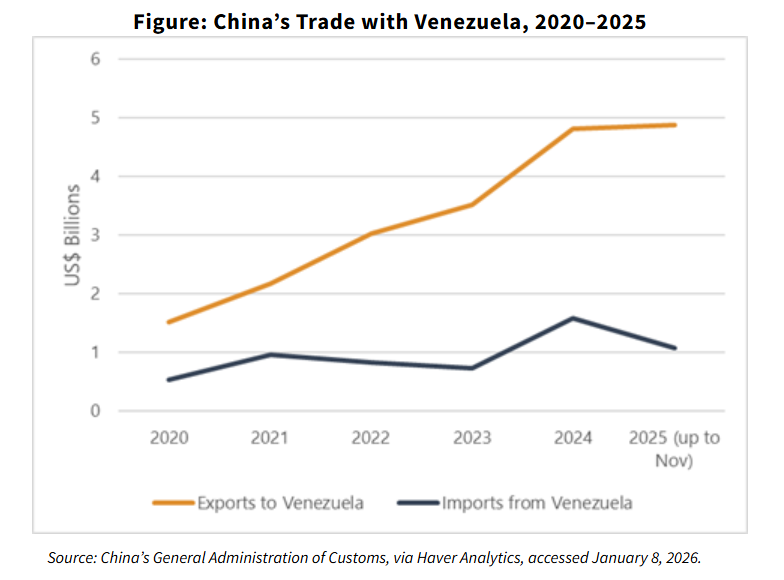
Figure: China’s Trade with Venezuela, 2020–2025
- Source: China’s General Administration of Customs, via Haver Analytics,accessed January 8, 2026
Venezuela holds the world’s largest proven oil reserves, and China’s official imports from Venezuela are over two-thirds oil and oil-related products. The future production and consumption of this oil has now been put under stress due to U.S. sanctions. The Wall Street Journal reported last month that U.S. President Donald Trump was considering exerting control over Venezuela’s state-run oil company, and being enclosed in uncertainty, Venezuela is unable to make false promises due to lack of institution. “China is welcome to come in and will make a great deal on oil,” Trump said on a flight to Mar-a-Lago on Air Force One on Saturday to CNBC reporters. Given the implementation of the baseline 10% tariff on all Chinese goods from the Trump Administration, the possibility of maintaining the relationship between the two nations is doubtful.
The sanctions in Venezuela will also indirectly affect other nations, such as Russia. This past week, the U.S. has established with India to lower tariffs with the intent to lower dependency on Russian oil. This deal would cause India to favor Venezuelan and U.S. crude resources, and strengthen that diplomatic relationship over time.
“The government has stated publicly on several occasions that ensuring the energy security of 1.4 billion Indians is the supreme priority of our government. Diversifying our energy sourcing in keeping with objective market conditions and evolving international dynamics is at the core of our strategy to ensure this,” said Randhir Jaiswal- spokesperson for New Delhi Ministry of External Affairs.
India has not confirmed the implications and agreement of the bargain. However, if the deal prolongs and eventually dwindles to no reliance on Russia, Russia will be left without an important ally. Without India’s fiscal contributions, funding for the war in Ukraine will take a massive hit.
The most important result of this action is how it affects the Venezuelan people. Given that Venezuela previously was considered to be authoritarian, the intervention of the U.S. led citizens to believe the result would be a form of new government. The U.S. prides itself on democracy and defending its ideas, however, the Trump Administration’s announcements have mainly focused on resource requests and increased drug trafficking control- not an approach to rebuild.
Even with the current U.S. presence, the old regime is set on projecting continuity to the citizens of Venezuela, according to NBC News. In their article they also focused on a domestic worker in Caracas who said , “After 25 years of a system that has made her poorer every day, Venezuelans have nothing to lose by trying something different.” It is clear that the citizens of Venezuela are looking for a government that provides the liberties and rights they desire, but as of right now it is unclear if that authority will fall unto Venezuelan officials, or the U.S.
Intervention in Venezuela has results that will extend beyond domestic and democratic affairs. The U.S. has obtained a position to influence economic ties, global energy diplomacy and access to a resource rich nation. Uncertainty for Venezuela’s stable future, is also uncertainty for their dependents.
Urging Influencers to Influence: The Relationship Between Social Media Influencers and Public Responsibility
It All Begins Here
Social media, the beloved apps most of the world use on a daily basis, are no longer used for the same pleasurable reasons anymore. The majority of the viewers on popular apps, such as Instagram and Tiktok, have turned to these platforms to get their daily news insights. As more and more political issues arise in the media, the younger generation has turned to their favorite content creators to hear these issues being spoken about; however many have failed to. The silence shown by content creators during these turbulent times, regarding politics, introduces the question of whether or not content creators have a public responsibility to speak on issues, when they obtain their platforms.
Since the 2020 quarantine era, studies have shown that one in five Americans alone rely on TikTok as their daily news source, as opposed to a cable source. According to the Pew Research Center, “Adults ages 30 to 49 have also increasingly been getting news on TikTok: A quarter now say they do so regularly, up from just 2% five years ago.” While social media users absorb the information being given to them through apps like Tiktok, users also begin to expect their favorite “influencers” to use their platforms as a way to speak on issues happening in our society on the daily.
In January of 2025, Donald Trump was inaugurated into his second presidential term, causing a large commotion in both society and on social media. Recently, the I.C.E raids happening across America have caused an outpour of emotions on social media; but they have also caused commotion among content creators and their large number of followers. While many of these “influencers” have spoken out against I.C.E, those who haven’t have raised questions regarding which side they agree with due to their silence on the matter.
The concept of staying quiet about politics went away in 2020, after the brutal murders of several Black-Americans under police brutality. As the “Black Lives Matter” protests began to arise all around the world, the political conversations being had through social media introduced the concept of urging influencers to speak out on these matters. The younger generations have learned that they no longer have to sit and just absorb the news through the television, but with the help of social media they can partake in speaking out on politics and worldly issues occurring.
As the media vastly becomes society's new source of news, information on political issues and movements spread like wildfire. In the article, “How Social Media Can Shape Public Opinion – and How We Can Build a Healthier Online Environment”, published by Georgetown University it states,
When something goes viral, it goes viral because a whole lot of people take action, hitting the like button, the retweet button, the share button. A whole lot of people decide that a piece of content or theme is so emotionally resonant, they are motivated to propel it onward. The audience collectively influences what gets seen by sending a signal to an algorithm, as opposed to in other media ecosystems where an editor, curator or publisher has the power to make that determination.
Algorithms on apps like Tiktok are catered to what the viewer enjoys interacting with, or more importantly who the viewer enjoys interacting with. When users enjoy a certain content creator, or “influencers” videos, it is easier to notice whether or not these creators have spoken up about the issues happening in our everyday societies. While many do speak out on these issues, those who stay quiet are those that receive the largest amount of backlash; as their silence is not taken well.
Why Do Users Place Public Responsibilities on Influencers?
Regular news sources, such as CNN and FOX News, tend to stay balanced in how they speak about politics in the media. Many social media users gravitate to certain influencers, and more importantly expect things from these influencers, because they feel these influencers share content that is both impactful and relatable in their lives. Being an “influencer” with millions of followers was never a real career option until recent years, which is another reason expectations are set on these influencers to speak on issues; as their followers are the ones setting up their career from the start. It is as if followers of a content creator believe in a loyalty between creator and follower, and as a result place a responsibility onto said influencer to speak out in support of those affected by political issues; like the ICE invasions.
Is it Being Honest or Being Ignorant?
We as individuals have created the idea that speaking up against something will do no good, as we are only “one person”; and what difference could only “one person” do? The truth is, however; that being the “one person” that speaks up can then urge five more to speak up, and then ten more, and so on. In order for influencers to speak up however, it would have to come from a genuine place. @Maggieeatsss on TikTok, stated shortly after President Trump began an ICE raid throughout the United States, that she didn’t see a point in speaking on politics as they don’t “apply much to her.” She received floods of backlash immediately in response to her video, specifically being called out for her ignorance to the matter. If we are urging influencers to speak up on their platforms, is it only to hear the side we agree with? As politics have become infiltrated into our daily conversations, the honest answer is yes we do want to hear influencers speak against the matter rather than stay modest or silent. Politics are no longer something we hear about on the news that affects what our school lunches look like. Politics today are a matter of life and death for many, the notion that “justice and freedom for all” only apply to some. This is why so many look to influencers to speak up, as a way of saying “we have supported your growing platform, now it is time for you to show that you support the right side of America.” For many, speaking up or staying silent is the fine line that determines how we perceive others, especially on social media.
College Student’s Impact on Tangible Policy Reform
It All Begins Here
In the history of the United States, we can trace back student protests to the heart of this country’s formative movements, which have impacted and changed the trajectory of the world as we know it. Today, these forms of protest have taken on an urgent, renewed, and needed form. Currently, students are faced with various social, political, and economic barriers, such as militarized immigration raids threatening their peers and the suppression of their academic freedom. These threats have given students encouragement to yet again fuse their individual identities into impactful collective movements within their communities. The politicization of student identity which is then facilitated by the unique community environment of a college campus, are empowering students to resist authoritarian threats and achieve significant policy change through their sustained nonviolent mobilization.
The psychology of modern protests are deeply rooted in the concept of our individual and collective identities. According to P.G. Klanderman in his journal on Identity Politics and Politicized Identities, a politicized collective identity is when people become involved in political protest on behalf of the group, that group itself becomes politicized, making them, “engaged as mindful and self-conscious collective” (4). This type of collective identity, where individuals participate in the movements activities, the outreach becomes a satisfying experience that reinforces one’s place in society. This is even more strengthened when, “...the interests of the group and/or the principles that the group value are threatened, the stronger is their motivation to take part in protest to defend their interest and principles” (5) For university students, a transformation from an individual to collective identity and action, is "instrumental motivation” (6), where participation serves as a tool to improve the situation of one’s own group when principles or peers are threatened. The university environment itself is uniquely suited for this because it fosters the free exchange of ideas among like-minded individuals who live in close proximity to one another. This “homogenous social network” encourages participation with peers and organizations (3). Consequently, a threat to one student, such as a peer facing unjust deportation, becomes a threat to the entire collective identity of the student body.
Amnesty International has documented a significant pattern of authoritarian practices aimed at shrinking civic space, including the targeting of universities and civil society. Currently the state and concern over our political and policy laden environment is described by Paul Obrien, Amnesty International’s Executive Director, as, “...a human rights emergency.”(Ringing the..., 4). One of the most prominent examples of this are the threats of the Trump administration’s “Catch and Revoke” initiative. This program uses AI-driven surveillance tools like Babel X and Palantir’s immigration OS to scan social media and track the movements of foreign born students (30). In 2025 alone, the State Department revoked 8,000 student visas, often targeting those engaged in peaceful protest or expression. Just this past February at Columbia University, ICE agents reportedly impersonated police officers to enter the campus residence and detain student Ellie Aghayeva. Such actions create this human rights emergency as it forces students to advocate for their own safety and that of their peers as a matter of survival and demonstration against injustice.
Additionally, there was a recent development where “Compact for Academic Excellence” used federal funding as a tool to pressure universities into abandoning Diversity, Equity, and Inclusion (DEI) initiatives and restrict the rights of transgender students. With this is also the rising prices for housing, necessities, and healthcare which have created significant hurdles for students. CIRCLE research indicates that youth who struggle financially are less likely to participate in traditional civic groups, as participating often requires time and resources they do not possess (Booth & Medina, 7). These authoritarian restrictions and revokings are being met with student movements like No Kings protests which have emerged to re-assert that ordinary Americans do not accept the types of policy change and exertion of power done by the elite class (Leingang, 4). Student movements are a part of a collective resistance that frequently draws on the tactics of NAACP and the Civil Rights Movement. Students are positioned to lead these charges or political advocation, as they are often more fearless or in “the middle of” the political actions being done. Students are described by Omekongo Dibing, a professor of peace, human rights and cultural relations, at American University, “They have less to lose in the present but more to lose in the future” (Tamhane, 1). This platform for action allows students to engage in the “trifecta” of activism manifested in social media organizing, protesting on the streets, and boycotting. The scale of the 2026 “No Kings” protests, which drew an estimated 8-9 million participants across 3,300 locations, demonstrates the sheer level of coordination and planning being done by ready young activists (Sozan, 1).
This student led movement and many like it in the pursuit of effective policy change is supported by the 3.5% rule. Political science research by Erica Chenoweth shows that when 3.5% of a population (which is approximately 12 million Americans) engages in sustained, nonviolent mobilization, it becomes near impossible for a government to ignore their demands (2). We can see this exercise in recent news in Minnesota. Following the fatal shooting of Renne Nicole Good and Alex Pretti, a strong effort involving strikes, community upheaval, and involved protests effectively forced the Trump administration to reduce the number of federal agents in the state. This community togetherness also contributed to the firing of DHS Secretary Kristy Noem. This success of a community’s call for policy and effective change shows that when those behind support of an administration, which boils down to our corporations, local politicians, and those in power begin to weaken in credibility or opposition against the wants of the people due to mass mobilization, the federal government is forced to give in, and listen to the demands of the people; people effectively are stronger in numbers.
The path towards policy reform and political advocacy is plagued with economic and political barriers, student activists remain the “best mediums of their own experiences” (Today's Student Coalition, 1). Movements like “No Kings” and recent demonstrations for the pursuit of policy reform on campus and off, serve as a catalyst for organizing a movement that bridges the gap between mass defiance and local community building. Effectively, if we continue to use our personal identities as students to come together as one community identity, and make an effort to ensure our peers are treated justly, leaders will be held accountable and policy will remain a true reflection of the people’s needs rather than the whims of those in power.
Meet the Writers & Editors