“Environmental Racism in Context to the AI Boom”
Writer: Payton Smith
Editors: Gwen Ericson, Sanya Shah, Ashley Herrera
The Scarlet Forum Vol. 1 — May 2026
Abstract
Environmental racism refers to the disproportionate exposure of marginalized racial and ethnic communities to environmental hazards and limited access to environmental benefits. This column examines environmental racism in Memphis, Tennessee, drawing on historical analysis and contemporary reports such as “Digital redlining: AI Infrastructure and Environmental Racism in Contemporary America” by Mario Desean Booker, “Environmental Racism and AI Data Centers” by Zhiyuan Wang, and “Historic Redlining...” by PJ Goedecke et al.
Furthermore, I will be using the Memphis based environmental justice group, Young, Gifted, and Green (YGG), as a case study alongside academic research on environmental racism and technology. This research argues that systemic inequalities, which are rooted in segregation, urban planning, and economic marginalization, have shaped environmental disparities in Memphis. It also explores how modern technologies, including artificial intelligence (AI), may both aggravate and help address these inequities. Ultimately, this paper aims to illuminate the persistence of environmental injustice and the need for policy interventions grounded in human rights.
Research
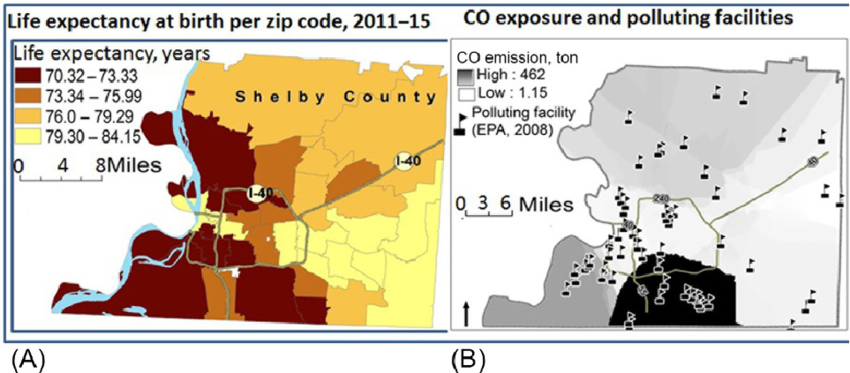
Environmental racism in Memphis is deeply tied to the city’s history of racial segregation and uneven urban development. Research done by Anzhelika Antipova at the University of Memphis (shown below) illustrates how life expectancy varies dramatically across neighborhoods, often along racial and economic lines. Communities with higher proportions of Black residents tend to experience shorter life expectancies, which are closely linked to environmental conditions such as pollution exposure, lack of green space, and proximity to industrial sites.
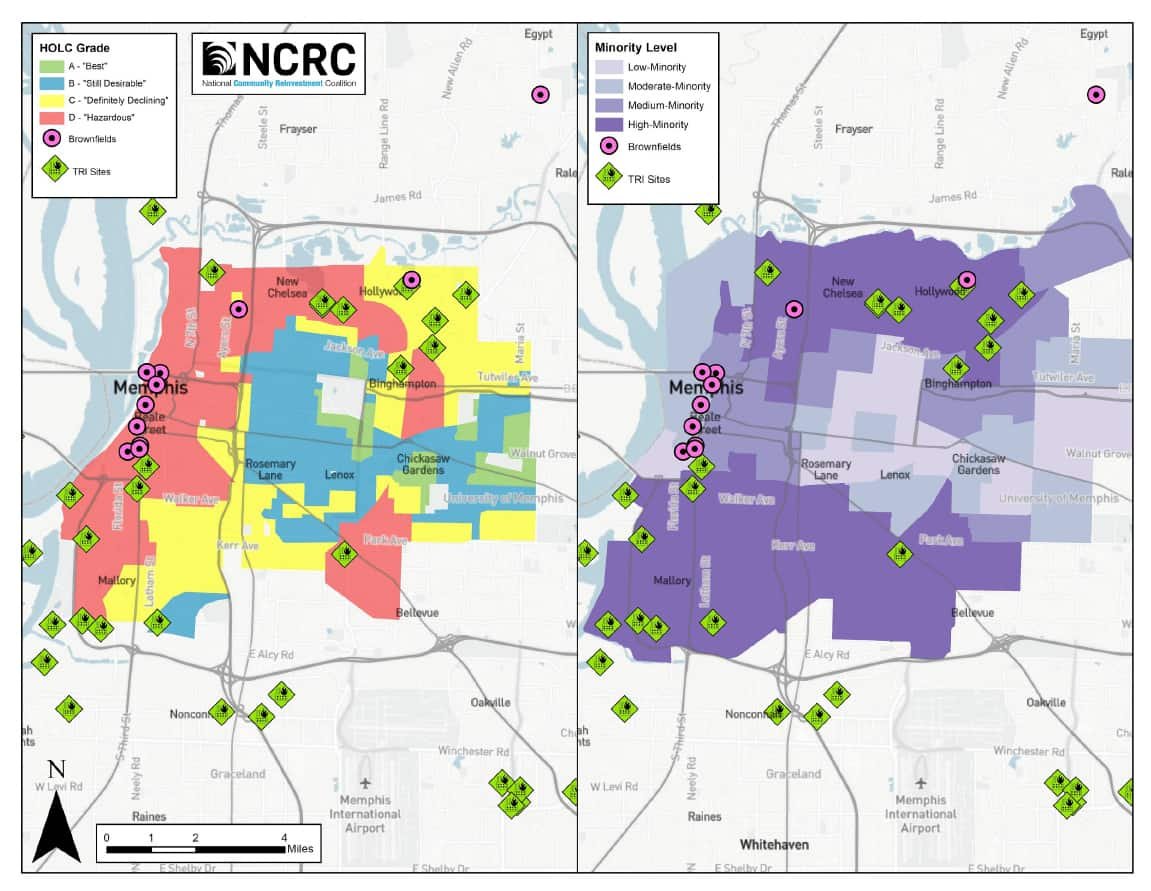
Historically, discriminatory housing policies, like redlining, confined Black residents to specific areas of the city. These neighborhoods were often located near highways, factories, and waste facilities, leading to increased exposure to pollutants. Over time, this residential inequality became embedded within the city of Memphis, reinforcing the concepts of poverty and environmental degradation. This results in a clear pattern, showing the juxtaposition between race and economy, and how they shape health outcomes and environmental risk.
The National Community Reinvestment Coalition (NCRC) data demonstrates that environmental factors are connected with broader social problems relating to health. Poor air quality, limited access to clean water, and inadequate infrastructure contribute to higher rates of chronic illness, including asthma and cardiovascular disease. These conditions disproportionately affect marginalized communities, which highlights the structural nature of environmental racism.
This pattern aligns with broader definitions of environmental racism found in public and academic literature. According to the YGG’s 17 Principles of Environmental Justice, environmental justice "demands the cessation of the production of all toxins, hazardous wastes, and radioactive materials, and that all past and current producers be held strictly accountable to the people for detoxification and the containment at the point of production.” In Memphis, this lack of environmental justice is evident in the uneven distribution of environmental burdens and benefits. Wealthier, predominantly white neighborhoods often have more parks, cleaner air, and better infrastructure, while poorer, predominantly Black neighborhoods face higher environmental risks.
In addition to historical factors, contemporary economic and political dynamics continue to shape environmental inequality in Memphis. Industrial development is often concentrated in areas with less political power, which is due to the lack of wealth, proper education, and less job opportunities. This creates a cycle in which vulnerable communities are repeatedly targeted for environmentally hazardous activities.
The role of technology, particularly artificial intelligence, introduces a new aspect of environmental racism. When speaking about covert racism in generative AI models, Pratyusha Ria Kalluri, a graduate student at Stanford, says “They generate text with terrible stereotypes from centuries ago, like calling speakers of African American English dirty, stupid, or lazy.”
This research through Stanford exemplifies how AI systems are not neutral as they reflect the biases present in the data used to train them and the perspectives of their developers. This has important implications for environmental policy and planning. For example, data-driven tools used to allocate resources and predict environmental risks may inadvertently prioritize certain communities over others, reinforcing existing inequalities.
Another concern is the environmental impact of AI itself. The development and use of AI technologies require significant energy and resources, contributing to carbon emissions and environmental degradation. These impacts are not evenly distributed as marginalized communities are more likely to bear the environmental costs of technological development while benefiting less from its advantages. This creates what scholars describe as a “double burden,” where disadvantaged populations face both environmental harm and limited access to technological benefits.
Despite these challenges, AI also has the potential to address environmental racism if used responsibly. For instance, AI-driven tools can improve environmental monitoring, predict pollution patterns, and enhance disaster response. These capabilities could help identify and mitigate environmental risks in vulnerable communities. However, achieving this requires careful attention to issues of equity, transparency, and accountability.
A human rights framework provides a useful lens for addressing environmental racism in Memphis. Principles of equality and non-discrimination emphasize that all individuals have the right to a safe and healthy environment. Applying these principles to environmental policy means ensuring that marginalized communities are not disproportionately burdened by environmental hazards and that they have meaningful participation in decision-making processes.
In Memphis, this would involve addressing both historical injustices and contemporary disparities. Policies could include stricter regulation of industrial pollution, investment in infrastructure and green spaces in underserved neighborhoods, and community engagement in environmental planning. Additionally, efforts to improve data collection and transparency could help ensure that technological tools are used in ways that promote equity rather than reinforce inequality.
Conclusion
Environmental racism in Memphis is the result of long-standing structural inequalities rooted in segregation, economic disparity, and unequal political power. The “Long Lives Memphis” project highlights the tangible consequences of these inequalities, showing how environmental conditions directly impact life expectancy and health outcomes.
The integration of modern technologies, such as artificial intelligence, adds complexity to the issue. While AI has the potential to improve environmental outcomes, it also risks increasing existing inequalities as it is not carefully regulated. Bias in data, unequal access to technology, and the environmental costs of AI development all contribute to the ongoing challenges of environmental justice.
Citations
Antipova, A. (2020, January). (PDF) analysis of exposure to ambient air pollution: Case study of the link between environmental exposure and children’s School Performance in Memphis, TN. Research Gate.
Booker, M. D. (n.d.). (PDF) Digital Redlining: Ai Infrastructure and Environmental Racism in contemporary America.
Environmental racism and AI Data Centers * by Zhiyuan Wang :: SSRN. (n.d.).
https://papers.ssrn.com/sol3/papers.cfm?abstract_id=6511579
Goedecke, P. J., Nelson, R., Walker, H., Gallaher, A. B., Hotz, K., Nakahara, A., Camp, L., Madlock, C., Sen, S., Singarella, I., Mari, G., Simpson, C., & Mockus, A. (2025, January 1). Historic redlining and hypertensive disorders of pregnancy: A retrospective cohort study. medRxiv.
https://www.medrxiv.org/content/10.1101/2025.06.16.25328662v1
Harris, R. T. (2021, September 24). Environmental justice and covid-19: Some are living in a syndemic " NCRC. National Community Reinvestment Coalition. https://ncrc.org/environmental-justice-and-covid-19-some-are-living-in-a-syndemic/
Miller, K. (n.d.). Covert racism in AI: How language models are reinforcing outdated stereotypes. Stanford HAI. https://hai.stanford.edu/news/covert-racism-ai-how-language-models-are-reinforcing-outdated-stereotypes
The principles of Environmental Justice (EJ). The Principles of Environmental Justice (EJ). (n.d.).