“Venezuela, U.S. Sanctions, and Shifting Global Power”
Writer: Maya Vives
Editors: Gwen Ericson, Sanya Shah, Ashley Herrera
The Scarlet Forum Vol. 1 — May 2026
U.S. sanctions on Venezuela can be perceived to have an internal focus of control, however the intervention will cause effects beyond Venezuela and their people. According to the Library of Congress, on January 3, 2026, U.S. forces captured Maduro and his wife and transported them to New York to face narco-terrorism charges (Seelke, 2026). With the removal of Maduro, U.S. The Department of the Treasury increased sanctions on Venezuela's government. By obtaining Venezuela’s authority, the U.S. will be able to manipulate oil diplomacy. The new found power will force nations such as China and Russia to rethink their relations with both Venezuela and the U.S., illustrating how our interference not only impacts domestic institutional recovery but realigns global energy diplomacy and power relations.
On Jan. 3, 2026, Nicolas Maduro and his wife were transferred to New York to face narco-terrorism, drug trafficking and weapons charges. The removal was framed as a U.S. campaign against drugs, however Maduro and Trump have maintained adversarial relationships previously. During Trump’s first term, the influx of Venezuelan immigrants and drugs resulted in the Administration charging Maduro with allegedly running narcoterrorism (Jeyaretnam et al., 2026), as reported in Time Magazine.
Although Venezuela’s January 2025 election resulted in Maduro’s third term despite not meeting international standards of democratic standards (Congress, 2024), the UN Security Council has had split reactions to the intervention. According to Congress’ report on the issue, the UN Secretary-General said U.S. actions set a "dangerous precedent," and some U.S. allies condemned the action. While Argentina, Ecuador and Peru are in support, China, Cuba and Iran have condemned the action.
According to the U.S.- China Economic and Security Review Commission, China is Venezuela’s second-largest trading partner after the United States. In the first 11 months of 2025, total trade has been around $6 billion, with a surplus of $3.8 billion. China purchases most of Venezuela’s oil, which also accounts for half of their fiscal revenue (Federici et al., 2026).
Venezuela holds the world’s largest proven oil reserves, and China’s official imports from Venezuela are over two-thirds oil and oil-related products. The future production and consumption of this oil has now been put under stress due to U.S. sanctions. The Wall Street Journal reported last month that U.S. President Donald Trump was considering exerting control over Venezuela’s state-run oil company, and being enclosed in uncertainty, Venezuela is unable to make false promises due to lack of institution. “China is welcome to come in and will make a great deal on oil,” Trump said on a flight to Mar-a-Lago on Air Force One on Saturday to CNBC reporters. Given the implementation of the baseline 10% tariff on all Chinese goods from the Trump Administration, the possibility of maintaining the relationship between the two nations is doubtful.
The sanctions in Venezuela will also indirectly affect other nations, such as Russia. February 9, 2026, the U.S. has established with India to lower tariffs with the intent to lower dependency on Russian oil. This deal would cause India to favor Venezuelan and U.S. crude resources, and strengthen that diplomatic relationship over time.
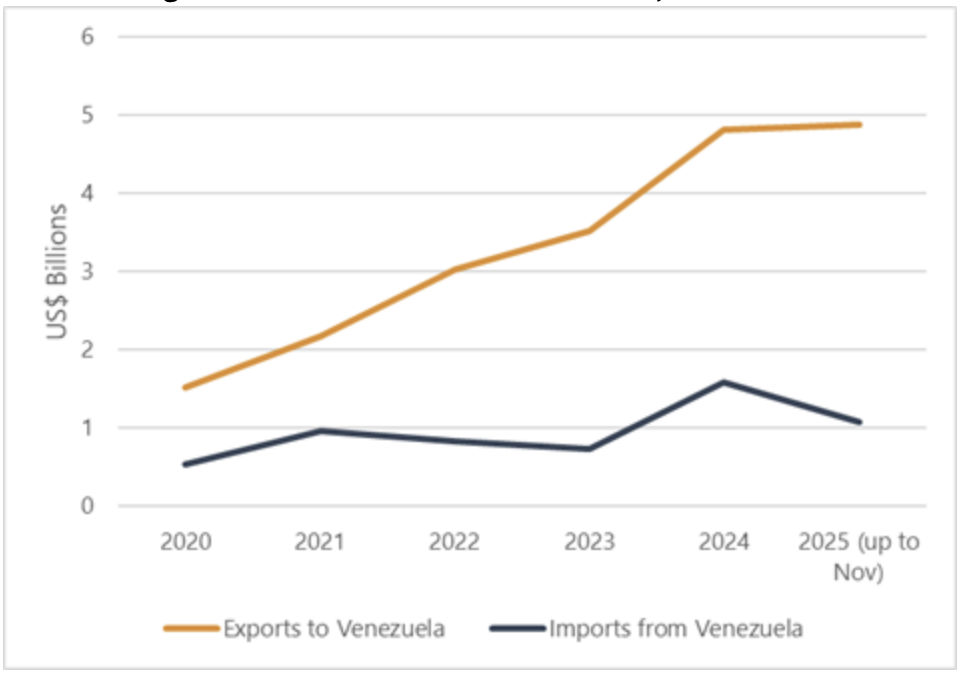
China’s Trade with Venezuela, 2020–2025
China’s General Administration of Customs, via Haver Analytics, accessed January 8, 2026.
“The government has stated publicly on several occasions that ensuring the energy security of 1.4 billion Indians is the supreme priority of our government. Diversifying our energy sourcing in keeping with objective market conditions and evolving international dynamics is at the core of our strategy to ensure this,” said Randhir Jaiswal- spokesperson for New Delhi Ministry of External Affairs in a press conference with Times of India (2026). India has not confirmed the implications and agreement of the bargain. However, if the deal prolongs and eventually dwindles to no reliance on Russia, Russia will be left without an important ally. Without India’s fiscal contributions, funding for the war in Ukraine will take a massive hit. India’s ability to change energy sources, reinforces how U.S. sanctions on Venezuela can shift dependence away from Russian oil.
The most important result of this action is how it affects the Venezuelan people. Given that Venezuela previously was considered to be authoritarian, the intervention of the U.S. led citizens to believe the result would be a form of new government. The U.S. prides itself on democracy and defending its ideas, however, the Trump Administration’s announcements have mainly focused on resource requests and increased drug trafficking control- not an approach to rebuild.
Even with the current U.S. presence, the old regime is set on projecting continuity to the citizens of Venezuela, according to NBC News. In their article they also focused on a domestic worker in Caracas who said , “After 25 years of a system that has made her poorer every day, Venezuelans have nothing to lose by trying something different.” It is clear that the citizens of Venezuela are looking for a government that provides the liberties and rights they desire, but as of right now it is unclear if that authority will fall unto Venezuelan officials, or the U.S.
Intervention in Venezuela has results that will extend beyond domestic and democratic affairs. The U.S. has obtained a position to influence economic ties, global energy diplomacy and access to a resource rich nation. Uncertainty for Venezuela’s stable future, is also uncertainty for their dependents.
References
Jeyaretnam, M., & Guzman, C. de. (2026, January 12). What’s happening with the U.S. andVenezuela, explained. Time. https://time.com/7344628/us-venezuela-trump-maduro-oil-drugs-war-explainer-questions-answered/
U.S. capture of Venezuela’s Nicolás Maduro: Considerations for Congress | congress.gov | library of Congress. (n.d.).
https://www.congress.gov/crs-product/IN12618
Author Joseph Federici. (2026, January 13). China-venezuela fact sheet. U.S.- CHINA | ECONOMIC and SECURITY REVIEW COMMISSION.
https://www.uscc.gov/research/china-venezuela-fact-sheet-short-primer-relationship
Bao, A. (2026, February 4). Venezuela tells China oil prices won’t be set by the U.S., seeks to reassure investment after Maduro capture. CNBC. https://www.cnbc.com/2026/02/04/venezuela-tells-china-oil-prices-us-seeks-to-reassure-investment-sanctions.html
Desk, T. N. (2026, February 5). “Energy security supreme priority”: MEA replies to Trump’s claim on Russian, Venezuelan oil; says decisions guided by national interest. The Times of India; The Times Of India.